

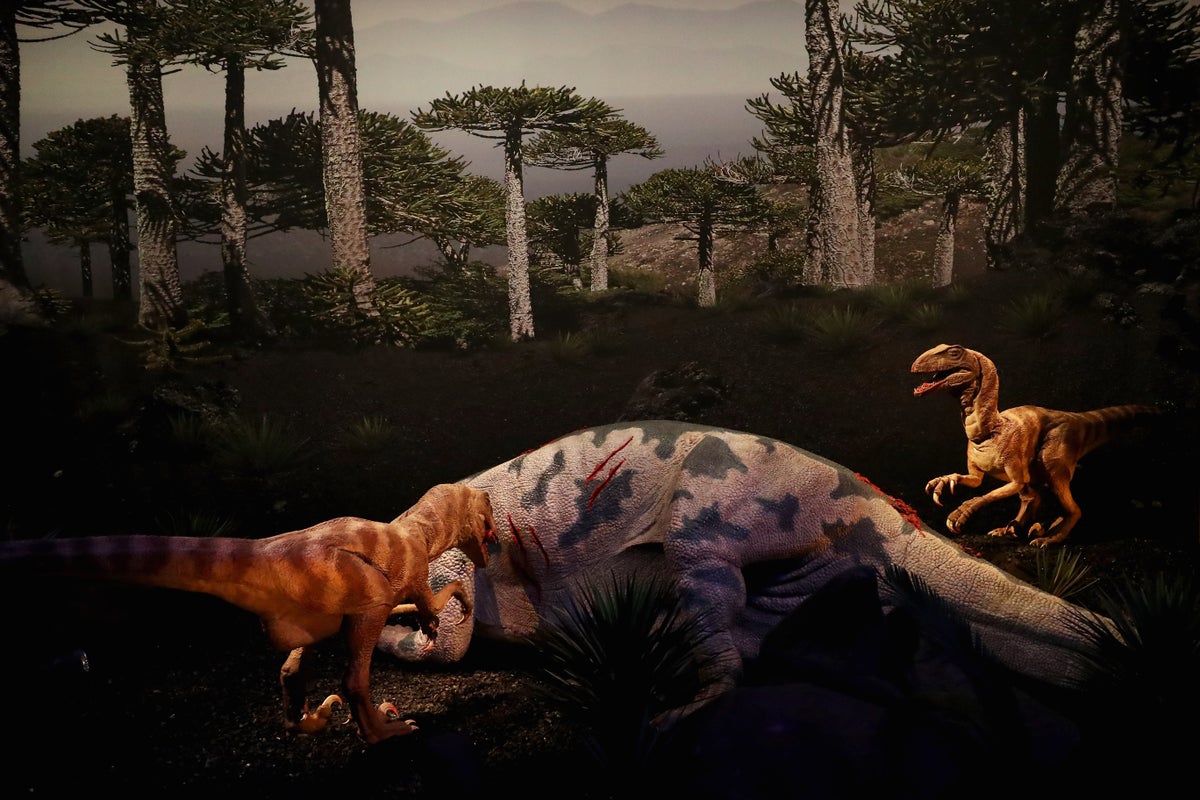
Some dinosaurs may have fed their young ones a softer and more nutritious food compared to that eaten by adults, according to a new fossil teeth study that sheds light on advanced parental care among the prehistoric reptiles.
Until now, juvenile dinosaurs were thought to have eaten smaller prey like insects in the case of carnivores, and fruits/shoots for plant-eaters.
But exactly how the young ones’ nutrition varied from that of their adult parents has remained unclear.
A closer analysis of their dental wear patterns show that while juvenile Maiasaura teeth had significantly more crushing wear, adults exhibited more shearing wear.
The findings suggest that adult Maiasaura parents brought softer, higher-protein food to their children than they themselves ate.
This proves that the urge we see in birds to feed their offspring is a “very old behaviour”.
“What we’re providing is that evidence for that behaviour probably goes much further than the origin of birds, perhaps to the origin of dinosaurs,” said John Hunter, an author of the study published in the journal Palaeogeography Palaeoclimatology Palaeoecology.
Researchers now believe juvenile Maiasaura likely ate more nutritious low-fibre foods like fruit while their caretakers consumed a greater proportion of tougher, nutritionally poor high-fibre plant parts.
The diet followed by the young ones may have caused them to grow particularly fast in their first year.
“Even among closely related dinosaurs, there is probably still quite a bit to learn about them,” Dr Hunter said.
“Taken together, it is highly likely that Maiasaurs had a reproductive strategy analogous to present-day birds, where the young have a fast rate of growth that is supported by the adults bringing food back to the nest that is of higher protein content than they themselves consume,” researchers concluded.