


About 90 per cent of humans across all cultures favour their right hand for tasks, and this dominance of right-handedness may have started when early human ancestors began walking on two legs, a new study finds.
Decades of research into handedness across species has revealed that no other primate species showed a population-level preference on this scale.
One’s genes, their brain, and the body’s development process from the womb all seem to work together to contribute to handedness.
“Our results suggest it is probably tied to some of the key features that make us human, especially walking upright and the evolution of larger brains,” said Thomas Püschel, an author of the study published in the journal PLOS Biology.
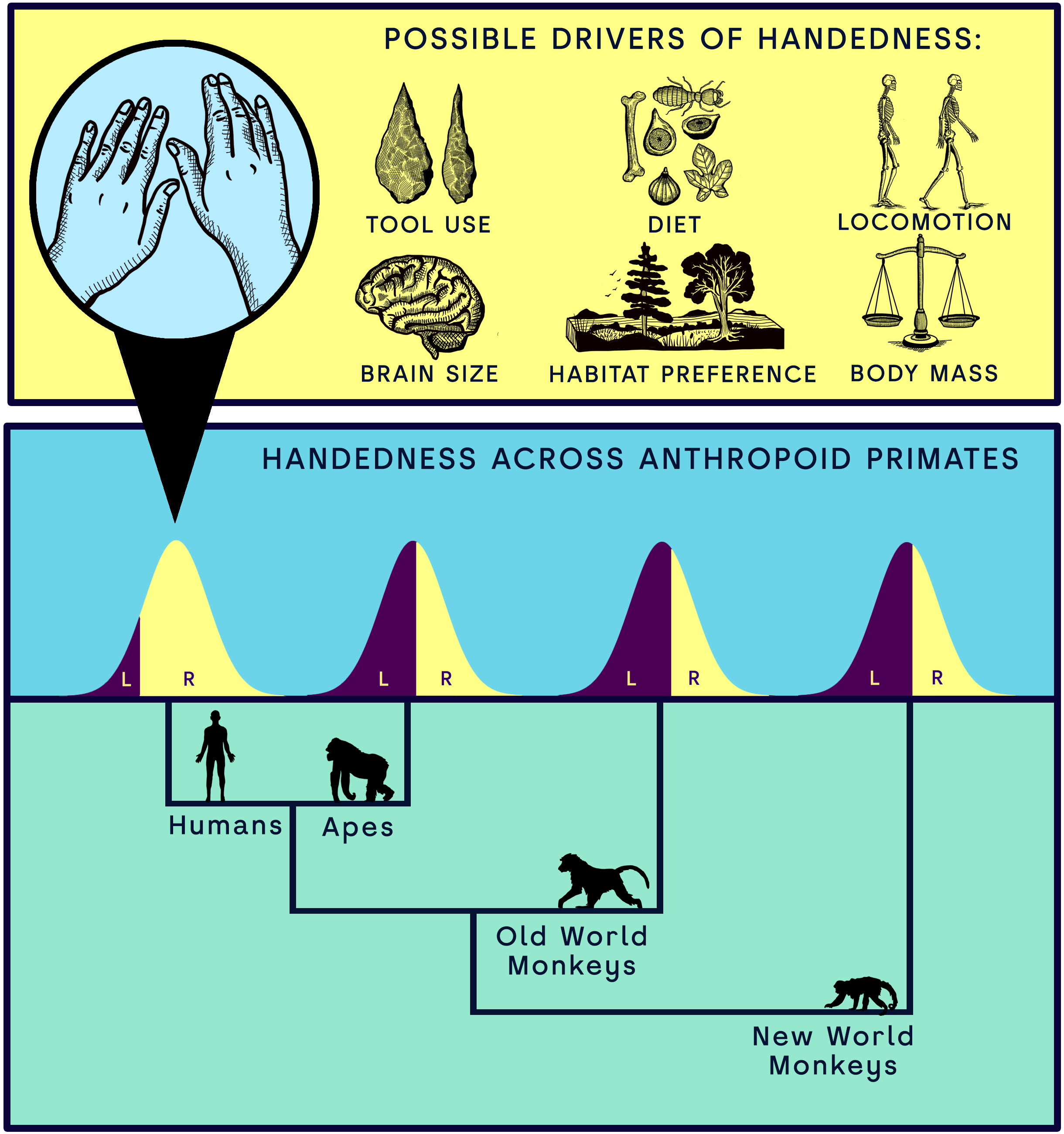
Scientists assessed data on 2,025 individuals across 41 species of monkeys and apes for the study.
Among these species, researchers tested which major existing hypotheses best explained how handedness evolved, including tool use, diet, habitat, body mass, social organisation, brain size and locomotion.
Scientists found the best theory explaining handedness when they factored in a large brain and the relative length of arms versus legs, a standard anatomical marker of two-legged movement.
Using these two traits, researchers could also estimate likely handedness in extinct human ancestors.
They found that early human ancestors like Ardipithecus and Australopithecus also may have had mild rightward preferences, similar to modern great apes.
But right-handedness seems to become more prominent in the genus Homo, including in Homo ergaster, Homo erectus and Neanderthals – reaching its modern extreme in Homo sapiens, and one exception being Homo floresiensis.
“By looking across many primate species, we can begin to understand which aspects of handedness are ancient and shared, and which are uniquely human,” Dr Püschel said.
In further studies, researchers hope to understand the role of human culture in stabilising right-handedness across populations and why left-handedness has persisted at all.