

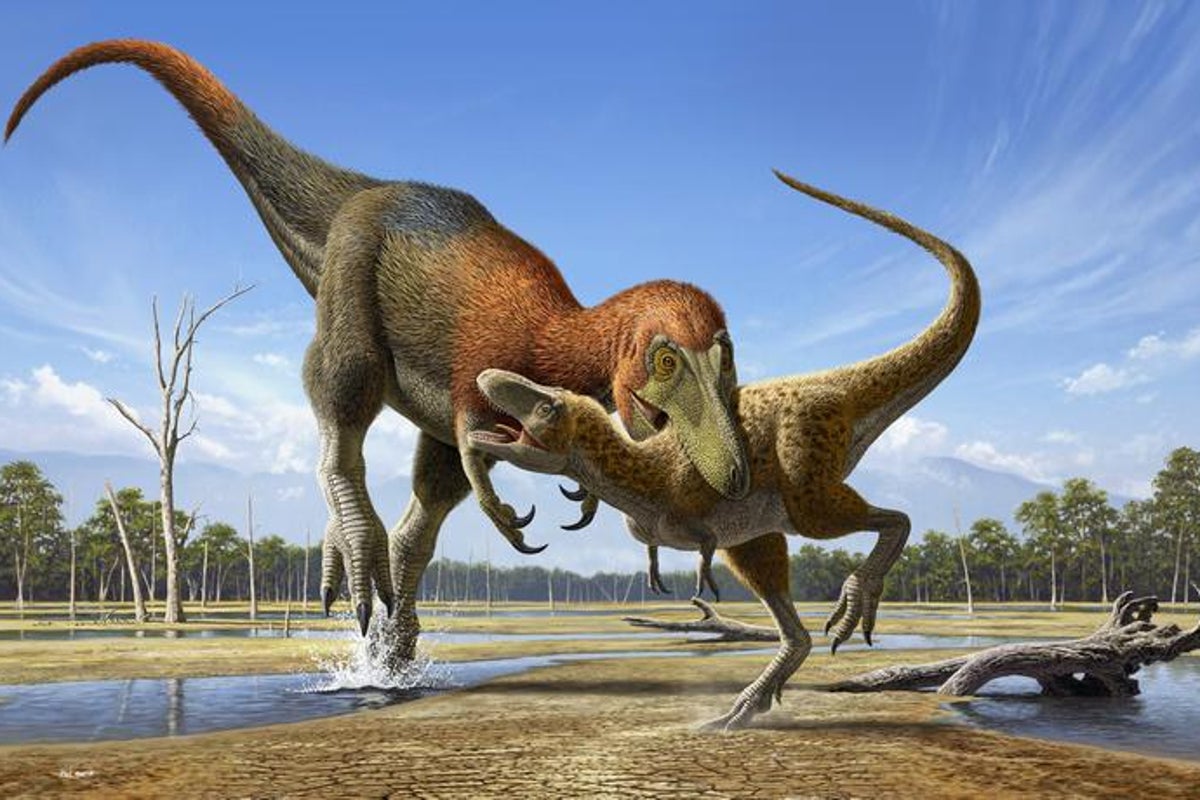
Mighty meat-eating dinosaurs like Tyrannosaurus rex had tiny arms because they used their powerful heads as the primary weapon, according to a new study.
The fearsome T rex was a massive dinosaur, growing 40ft long and 20ft tall, but had comically tiny forelimbs. T rex was one of five dinosaur groups with such short forelimbs.
Scientists have long debated why their arms were only about 3ft long, comparable to the forelimbs of humans.
“We sought to understand what was driving this change and found a strong relationship between short arms and large, powerfully built heads,” said Charlie Roger Scherer, author of the study published in the journal Proceedings of the Royal Society B Biological Sciences.
“The head took over from the arms as the method of attack. It’s a case of ‘use it or lose it’. The arms are no longer useful and reduce in size over time,” explained Mr Scherer, a PhD candidate at the University College London.
Giant head adaptations in dinosaurs started in areas with gigantic prey. In this prehistoric world, trying to grab and pull a 100ft sauropod with claws was less ideal than attacking and holding on to it with jaws.
Growing prey size likely led to an “evolutionary arms race” that saw dinosaurs developing strong skulls and jaws, providing the ability to better subdue prey.
In the study, researchers quantified skull robustness by factoring in its dimensions, how tightly the head bones were connected, and the bite force of the jaw. They found that T rex scored the highest, followed by the Tyrannotitan, another two-legged dinosaur nearly as massive as T rex which lived in modern-day Argentina in the Early Cretaceous period 145-100 million years ago.
In future studies, researchers said they hoped to better understand how the functioning of the small forelimbs helped in the evolution of feathers and flight.
“These events resulted in a shift from subduing prey using grasping forelimbs to using powerful bites and robust skulls,” they wrote.