

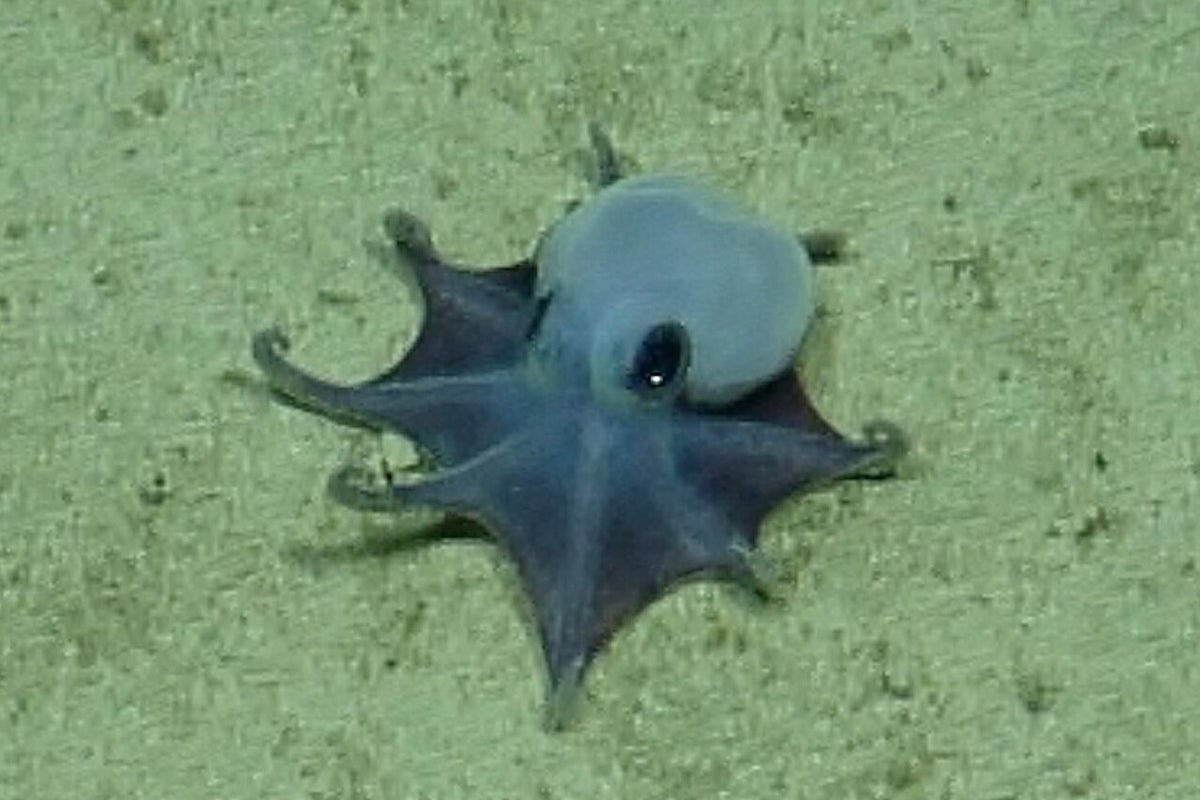
A palm-sized blue octopus first spotted off the Galapagos Islands in 2015 has been identified as a new deep-sea species, according to a new study.
The octopus, now named Microeledone galapagensis, was spotted during a deep-sea expedition aboard the research vessel EV Nautilus.
The vessel’s crew had deployed a remotely operated robot to explore the seafloor near Darwin Island at the northern edge of the Galápagos archipelago. As the robot moved near an underwater mountain, its camera caught the strange octopus about 5,800ft below the surface.
The octopus was preserved in alcohol and formalin and sent to the Chicago Field Museum for research.
"Right away, I knew it was something really special. I'd never seen anything like it,” said Janet Voight, an author of a new study on the octopus published in the journal Zootaxa.
The Chicago scientists faced a hurdle as they had a single specimen to look at. “When you describe a new species of octopus, you have to look at all the parts, including the mouth, the beak and the teeth,” Dr Voight explained.
“And to see those things, you have to cut the specimen open. We only had the one specimen, so I didn't want to take it apart.”
To conduct a much more thorough analysis of the specimen at hand, the researchers took CT scans.
"Because CT imaging is non-destructive, it's especially important for type specimens like this one,” said Stephanie Smith, another author of the study.
“And that's great for me because people are often bringing me these incredibly rare and stunningly beautiful specimens that I get the privilege of virtually opening up.”
The discovery of the octopus species, the researchers note, is a reminder of how much of the ocean around the Galápagos Islands remained unexplored.
“Every new species helps us better understand these hidden ecosystems, and why protecting them matters,” Salome Buglass, marine scientist from the University of California Los Angeles, said.