

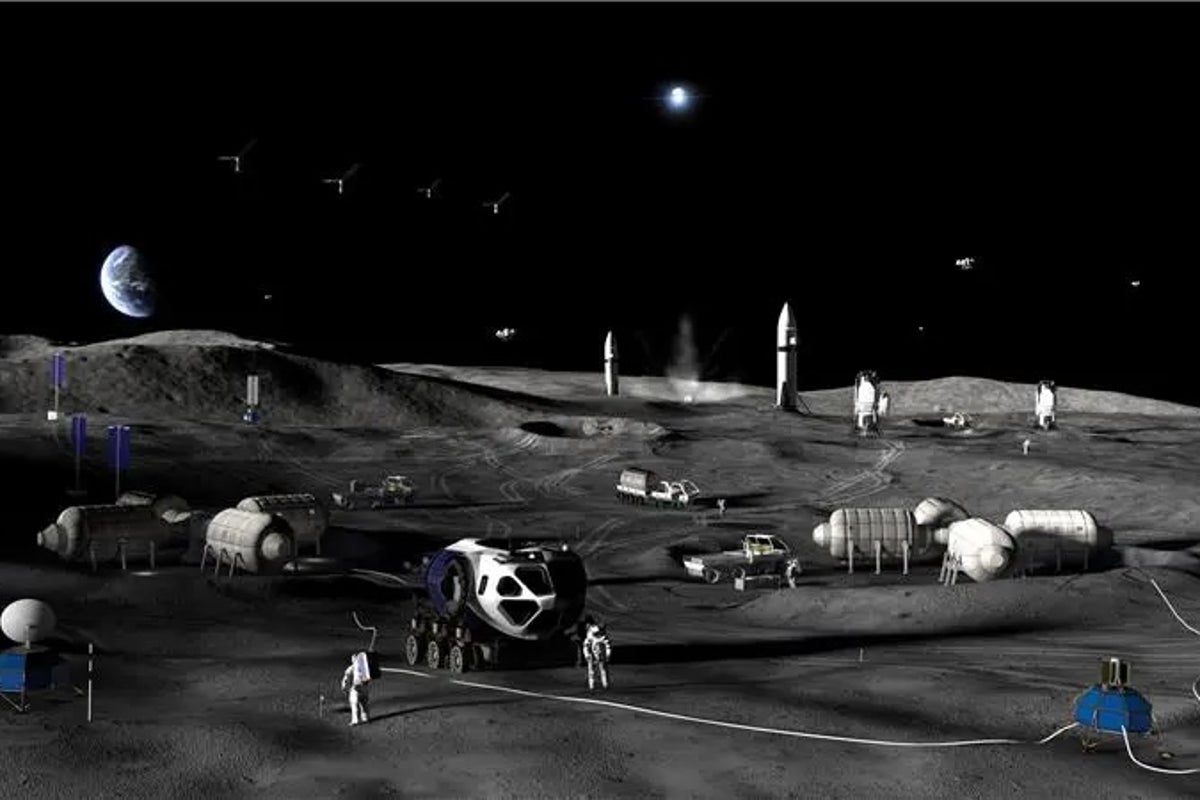
The first missions toward building a base on the moon will launch before the end of the year, NASA leaders announced Tuesday.
“We are leveraging the NASA playbook from the 1960s, figuring out what works and what doesn’t in this epic science of survival,” NASA Administrator Jared Isaacman told reporters at a news conference, “because the moon base is as beautiful as it is hostile.”
The base will serve as an outpost for astronauts in the Artemis program who are working to help send humanity farther from Earth than ever before - eventually to Mars.
The second mission will be the largest commercial payload delivered to the lunar surface, including a rover from the company AstroLab, and the third will deliver a payload from the European and Korean Space Agencies.
Both are missions slated to launch by the end of the year. But Isaacman said they represent the first of more than a dozen that his agency will announce in the coming months.
NASA leaders also announced several other commercial partners involved in the effort. AstroLab and Lunar Outpost were chosen to develop lunar terrain vehicles. Astronauts will drive the AstroLab vehicles on the lunar surface.
“These things can go up to 10 kilometers per hour and go up and down slopes of 20 degrees,” said Carlos García-Galán, the program executive.
Lunar Outpost’s autonomous driving vehicles will map terrain to potentially find future moon base sites.
There will be 25 launches, 21 landings and 400 metric tons of cargo in the first phase of the moon base program.
All of the launches will help NASA transition to phase two: assembling semi-permanent infrastructure and early habitation by 2029.
Nuclear reactors that will power the base could be launched to the moon as soon as 2030, the Trump administration said in April. Phase three, which is projected for 2032, will help to achieve a sustained presence on the moon, with continuous surface activity.
Overall, the base is expected to cost over $20 billion and the Artemis program around $93 billion.
The Artemis program has already seen major success, sending four astronauts around the dark side of the moon back in April to prepare for upcoming crewed flights to the moon.
NASA says trips to the moon and Mars are crucial to help us understand the origins of life. Mars is one of the only other places where we know life may have existed.
“With the moon base, Artemis astronauts will stay longer, explore farther and conduct the kinds of science that advances exploration itself, understanding how humans operate off world, how we build infrastructure and how we prepare for Mars,” Lori Glaze, acting associate administrator of NASA’s Exploration Systems Development Mission Directorate, said.