

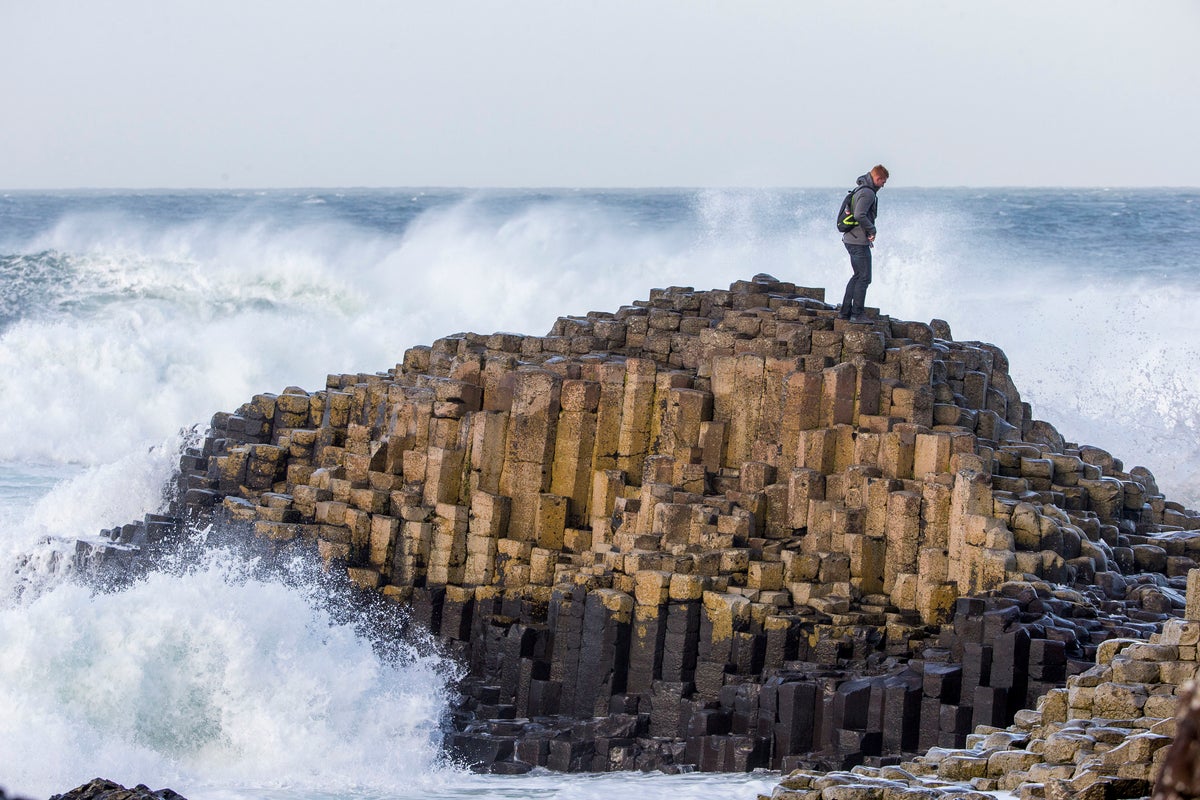
The geological timeline for Northern Ireland's iconic Giant's Causeway has been dramatically revised following new scientific research.
New findings indicate that the volcanic activity responsible for the distinctive 40,000 basalt columns occurred over a significantly condensed period.
Scientists now believe the region's volcanic events, including those forming the Causeway, transpired in just 5.5 million years – a staggering eight million years less than earlier estimations.
The Giant’s Causeway’s distinctive landscape was formed during intense volcanic activity which forced molten rock up through cracks in the earth.
Thick lava flows then cooled, contracted and cracked, creating about 40,000 basalt columns.
Dr Tapster said the cutting-edge research by the Geological Survey of Northern Ireland (GSNI) and the BGS, has reconstructed a new timeline for volcanic activity across Northern Ireland.
It has allowed researchers to place the volcanic activity that led to the formation of the Giant’s Causeway within a much more precise global context for the first time.
The research has significantly updated the understanding of when specific volcanic events happened in Northern Ireland.
As a result, scientists can more confidently connect those events to activity and landmarks elsewhere, including Scotland.
Dr Tapster said; “By looking at the timescales and the high resolution timeline, we’re able to match it up with various other locations, particularly in the Inner Hebrides in Scotland, the volcanics of Mull, Rum, the Isle of Skye, and taking a bigger view, looking at Greenland and the Faroe Islands.”
The research is part of a wider initiative at the British Geological Survey to improve the understanding of the UK’s geology through better quantifying geological time in the rocks around us.