

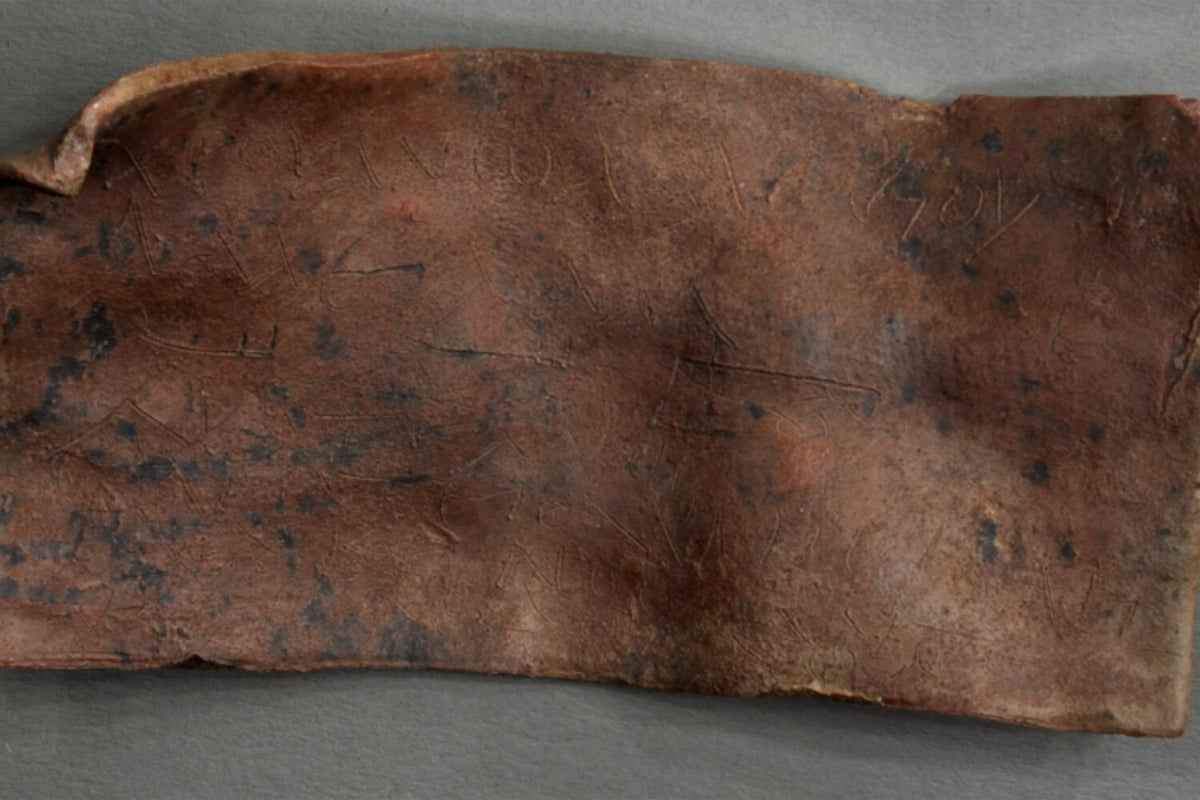
A Roman tablet unearthed in the Netherlands has been deciphered and found to contain "magical" spells to invoke deities and demons to harm enemies.
The artefact was found at an archaeological site in the Roman province of Lower Germania in the Dutch municipality of Heerlen.
Measuring about 9.3 by 4.8cm (3.7 by 1.9in), the tablet was found to contain text, not in Latin as was common for the period, but in ancient Greek written in the Egyptian style.
Smaller curse tablets were inscribed with spells or binding charms and then buried in order to influence or "bind" opposing litigants, athletic opponents or romantic rivals.
Researchers uncovered the Heerlen tablet at a pit beneath the Town Hall square, which in the second century was a site of the former Roman military settlement of Coriovallum.
To uncover the writing, scientists used a computer-assisted photographic technique, which involved taking multiple images of the inscription using variable lighting.
Individual photos were then digitally combined into a single image, allowing even the smallest surface features to stand out.
The tablet was found to invoke various deities and demons in the Egyptian style, but composed in ancient Greek.
Some practices related to protection and healing were officially recognised and accepted as part of religious life, while in those carried out in one's own interests and at the expense of others were done in secret.
"In the early centuries AD, Near Eastern, Egyptian, Jewish, and sometimes even Christian traditions increasingly merged and spread throughout the entire Roman Empire of that time – a development that the discovery from Heerlen impressively underscores,” said Egyptologist Joachim Quack from Heidelberg University.