

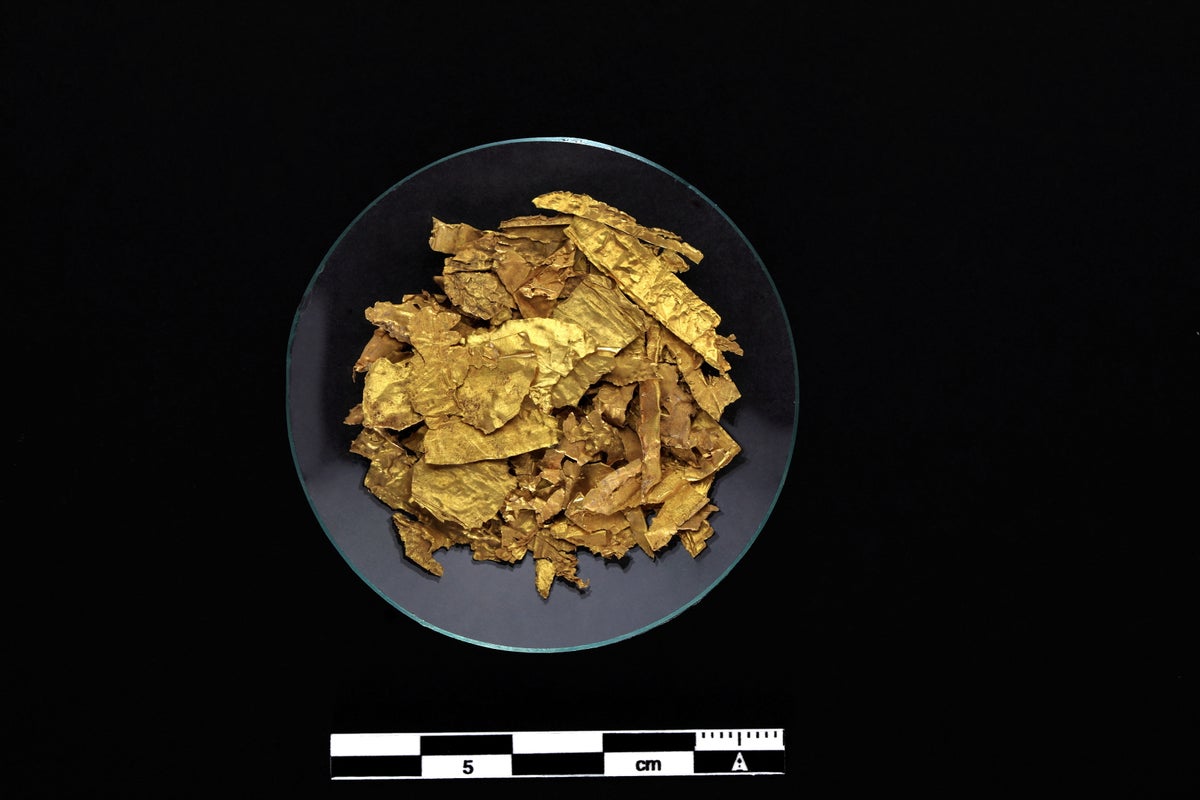
Medieval alchemists dreamed of transmuting lead into gold.
Today, we know that lead and gold are different elements, and no amount of chemistry can turn one into the other.
But our modern knowledge tells us the basic difference between an atom of lead and an atom of gold: the lead atom contains exactly three more protons. So, can we create a gold atom by simply pulling three protons out of a lead atom?
As it turns out, we can. But it’s not easy.
While smashing lead atoms into each other at extremely high speeds in an effort to mimic the state of the universe just after the Big Bang, physicists working on the ALICE experiment at the Large Hadron Collider in Switzerland incidentally produced small amounts of gold.
Extremely small amounts, in fact: a total of some 29 trillionths of a gram.
How to steal a proton
Protons are found in the nucleus of an atom. How can they be pulled out?
When the lead nuclei have a head-on collision, the strong nuclear force comes into play, and they end up getting completely destroyed. But more commonly, the nuclei have a near miss and only affect each other via the electromagnetic force.
The strength of an electric field drops off very quickly as you move away from an object with an electric charge (such as a proton). But at very short distances, even a tiny charge can create a very strong field.
So when one lead nucleus just grazes past another, the electric field between them is huge. The rapidly changing field between the nuclei makes them vibrate and occasionally spit out some protons. If one of them spits out exactly three protons, the lead nucleus has turned into gold.

Counting protons
So if you have turned a lead atom into gold, how do you know? In the ALICE experiment, they use special detectors called zero-degree calorimeters to count the protons stripped out of the lead nuclei.
Once a lead nucleus has transformed by losing protons, it is no longer on the perfect orbit that keeps it circulating inside the vacuum beam pipe of the Large Hadron Collider. In a matter of microseconds, it will collide with the walls.
This effect makes the beam less intense over time. So for scientists, the production of gold at the collider is in fact more of a nuisance than a blessing.
However, understanding this accidental alchemy is essential for making sense of experiments – and for designing the even bigger experiments of the future.