

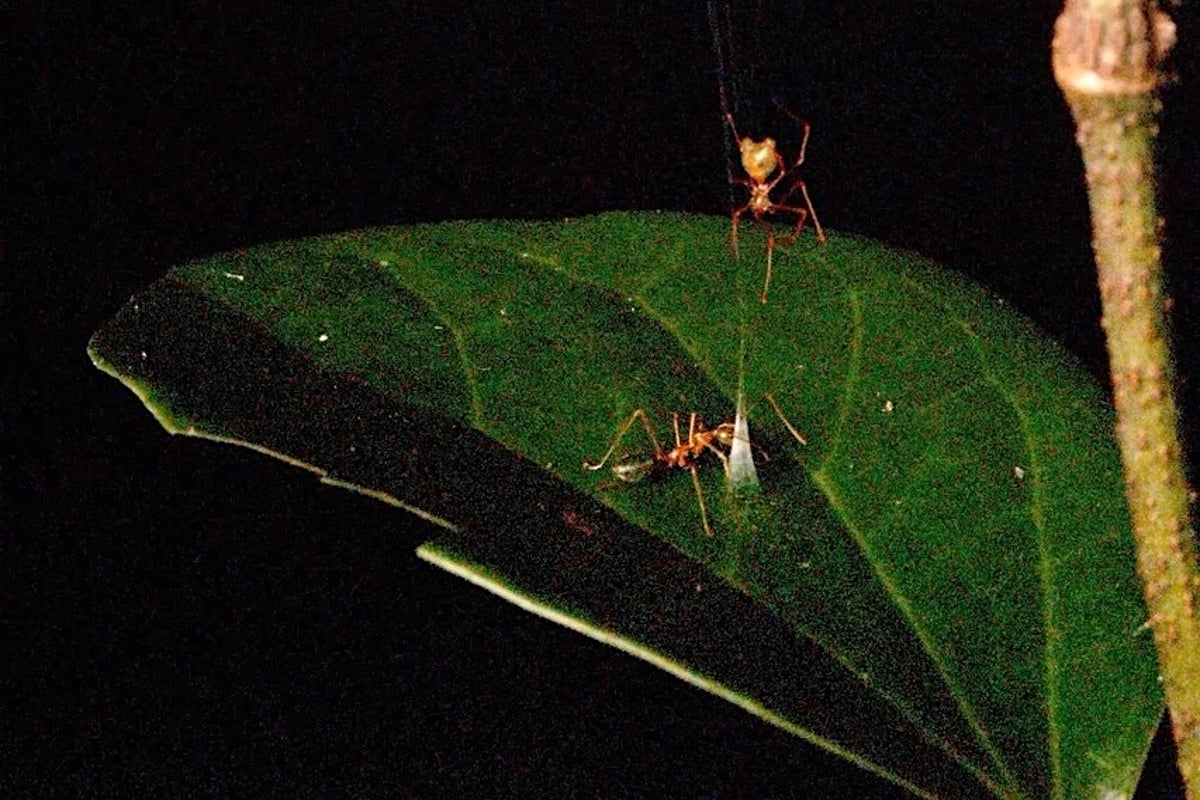
A new spider species has been discovered in the rainforests of north Queensland that is capable of weaving powerful spring-like snares that trap and launch prey at an astonishing speed.
The spring-actuated snare is built to catch only one species of ant, one at a time, in what researchers describe as “the ultimate specialisation”.
Dubbed the ballista spider, after the ancient Roman weapon that launched bolts or stones, it has evolved its special ability to trap only the highly territorial and aggressive green tree ant Oecophylla smaragdina, scientists say.
Researchers were perplexed at first that the spider’s diet consisted mainly of ants, a challenging prey. “Ants have a range of chemical defences – including the ability to sting in some species – and they use alarm signals to rapidly recruit hundreds and even thousands of other ants as backup to overcome potential predators,” said Ajay Narendra, an author of the study from Macquarie University.
“It’s very unusual for a spider to feed on ants, because they’re notoriously dangerous, and even more bizarre to find a spider that eats only one particular ant species,” Dr Narendra said.
Scientists observed that during the day, the ballista spider tends to take refuge on the underside of leaves above areas where the green tree ants are actively foraging.
Then, as night falls, the spider descends 50cm or more to lay an anchor point on the leaf, a branch, or the forest floor.
It spends up to four hours at this point engineering 15-60 vertical silk tension lines bundled together in a cone near the ground.
The spider engineers its snare to store elastic energy and rapidly release it, researchers say.
It waits for the ant to be fully entangled in its web before wrapping it further with silk.
“We suspect during the final construction stage the spider adds a pheromone that specifically lures worker ants and induces an aggressive attack, triggering the snare,” Dr Narendra said.
“This seems to be the only case where a spider’s web is designed to catch a single prey species, and where the mechanism is triggered by the prey rather than by the predator,” he explained.
Researchers theorise that the snare mechanism evolved as a highly specialised way for the spider to pick off potentially hazardous prey one at a time and transport them away from ant trails and nests.
They also suspect that the spider has evolved to only hunt one species of ant that follows predictable trails, and behaves in ways that make this ambush strategy effective.