

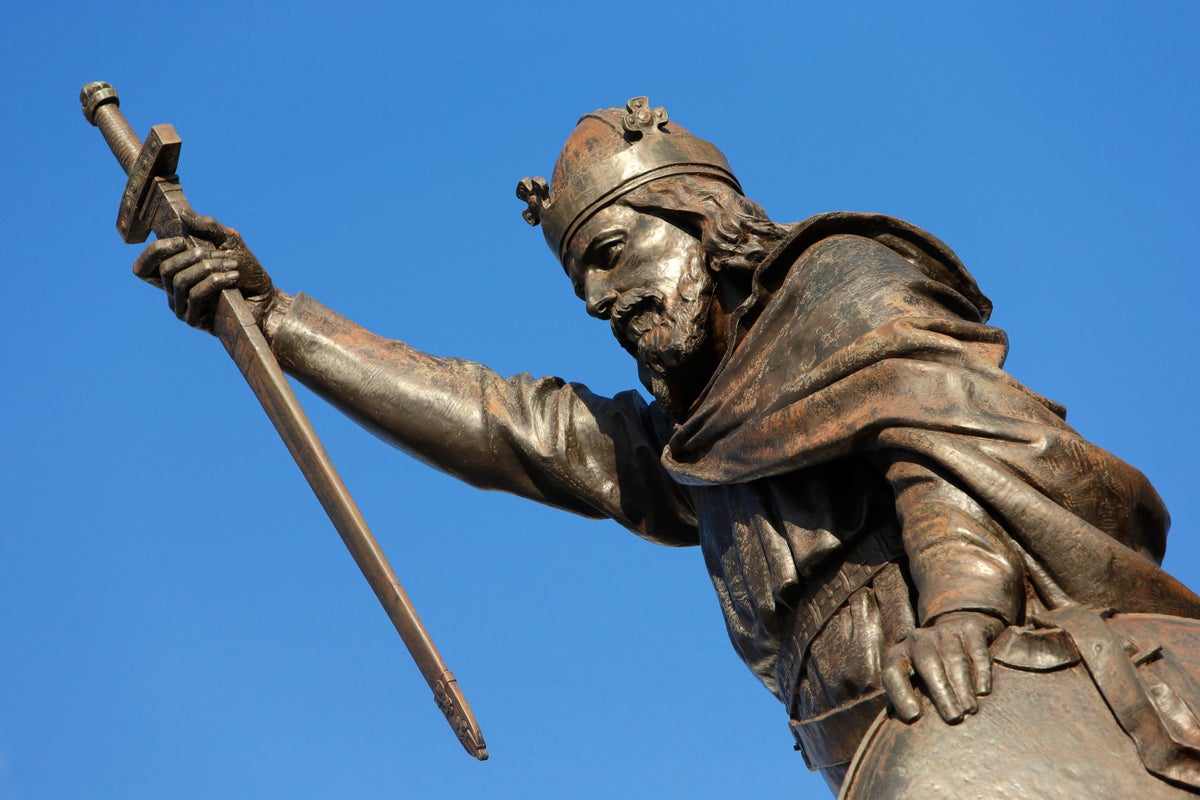
A historical researcher claims he has identified the location of the remains of King Alfred the Great in a Winchester car park.
King Alfred the Great ruled over Wessex, an Anglo-Saxon kingdom which now forms modern-day south and south-west England, from 871 to 899.
He is widely recognised for introducing lasting reforms in law, education, and state administration during the Early Medieval period, which laid the foundations for the unification of England in 927.
Researcher Graham Phillips, a self-described “real-life Indiana Jones”, has authored 27 books examining historical mysteries, including the treasure of Solomon and the death of Napoleon.
But the search for the remains of the King has spanned well over a century, encountering several hurdles such as misidentified bones and excavating the wrong grave entirely.
Now, Mr Phillips claims that the remains lie in a Winchester car park, 20 yards from a garden slab which has marked the King’s presumed grave for the past 23 years.
Speaking to BBC Radio Solent, he said: "Bizarrely, like Richard III, the bones are under a car park."
King Alfred was first buried at Winchester's Old Minster following his death in 899, and he was then moved to the New Minster by his son, Edward the Elder. In 1110 he was moved again to Hyde Abbey.
Following the abbey’s demolition in 1539, the exact whereabouts of the King’s remains were unconfirmed until 1866, when antiquarian John Mellor excavated the site during the construction of a workhouse. The remains found at the site were reburied at St Bartholomew's Church.
The alleged “nephew-killer’s” body was found 500 years after his death, marking one of the strongest archaeological identifications of a named historical individual ever achieved, according to the archaeology team at the University of Leicester.
Mr Phillips's claim has not yet been independently reviewed by any archaeologist or heritage body.
The University of Winchester refrained from commenting on the researcher’s claim, saying finding the resting place of King Alfred is “complex”. It added it continues to work closely with Hyde900’s community archaeology project to investigate the abbey complex.
Dr Katherine Weikert, head of the school of humanities at the university, said: “Our medieval past is filled with meaning for today’s world. It is always great to see people excited about medieval history, and doubly so when it comes to Alfred here in Winchester.”
Without permission to survey the site, Mr Phillips accepted some investigations can remain unresolved.
”Very often I can find good proof to finalise the argument,” he told the BBC. “But very often it's left open, and somebody else in the future may have to take it up."