

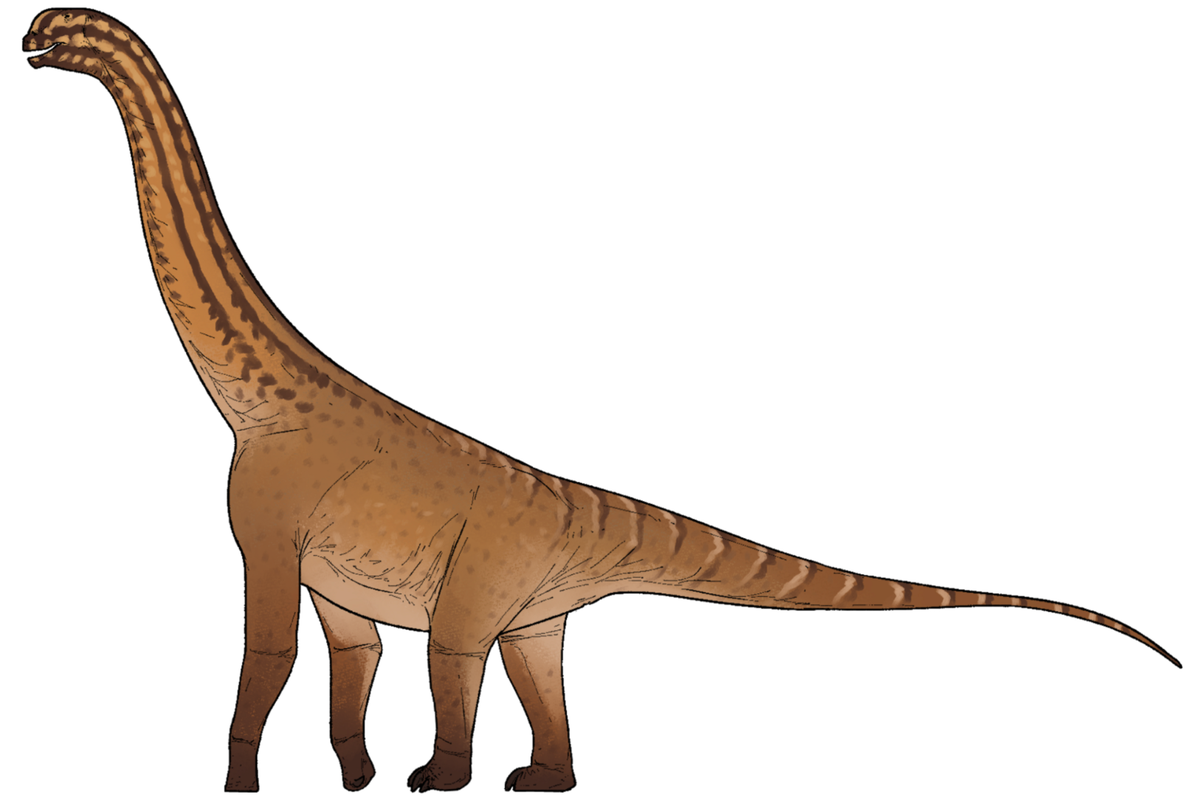
A peculiar fossil of a long-necked reptile unearthed in India has pushed back the timeline of the popular colossal dinosaur group’s spread by tens of millions of years.
The new fossil discovered in the eastern Indian state of Gujarat belongs to the group called neosauropods, which eventually evolved into a group of colossal dinosaurs that includes Diplodocus, Brachiosaurus and Argentinosaurus.
But unlike these titans, the newly uncovered species, Ceratocaudia antiqua, measured only about 7m (23 feet) long.
The rocks where the dinosaur fossil was found span from the Early Jurassic to the Bajocian stage of the Middle Jurassic, making the dinosaur as much as 190 million years old.
This is about 10 million years older than the previous oldest identified neosauropods, meaning these dinosaurs roamed the planet much earlier than thought.
The discovery makes the dinosaur the oldest known neosauropod, living at a time India was still part of the southern supercontinent Gondwana.
“Ceratocaudia antiqua is the earliest diagnosable macronarian neosauropod from India and represents one of its earliest global occurrences,” scientists wrote in the study published in the Journal of Vertebrate Palaeontology.
“We report a partial skeleton of a small sauropod dinosaur from the upper Lower Jurassic to Bajocian strata of the Kaladongar Formation (Khadir Uplift), Kachchh Basin, India,” they wrote.
In the latest study, researchers also digitally reconstructed Ceratocaudia antiqua and compared its tail musculature with that of modern crocodiles and lizards.
Their computer analysis suggests the sauropod dinosaur kept its tail horizontal and may have swung it forcefully from side to side to defend against predators.
“A hypothetical caudal musculoskeletal reconstruction of C. antiqua, generated using retrodeformed and reconstructed elements of the holotype, is used to determine tentative functional morphological implications, including the use of the tail as a mild deterrent to predators,” researchers wrote.
The fossils are currently housed at the Vertebrate Palaeontology Lab of IIT Bombay.