

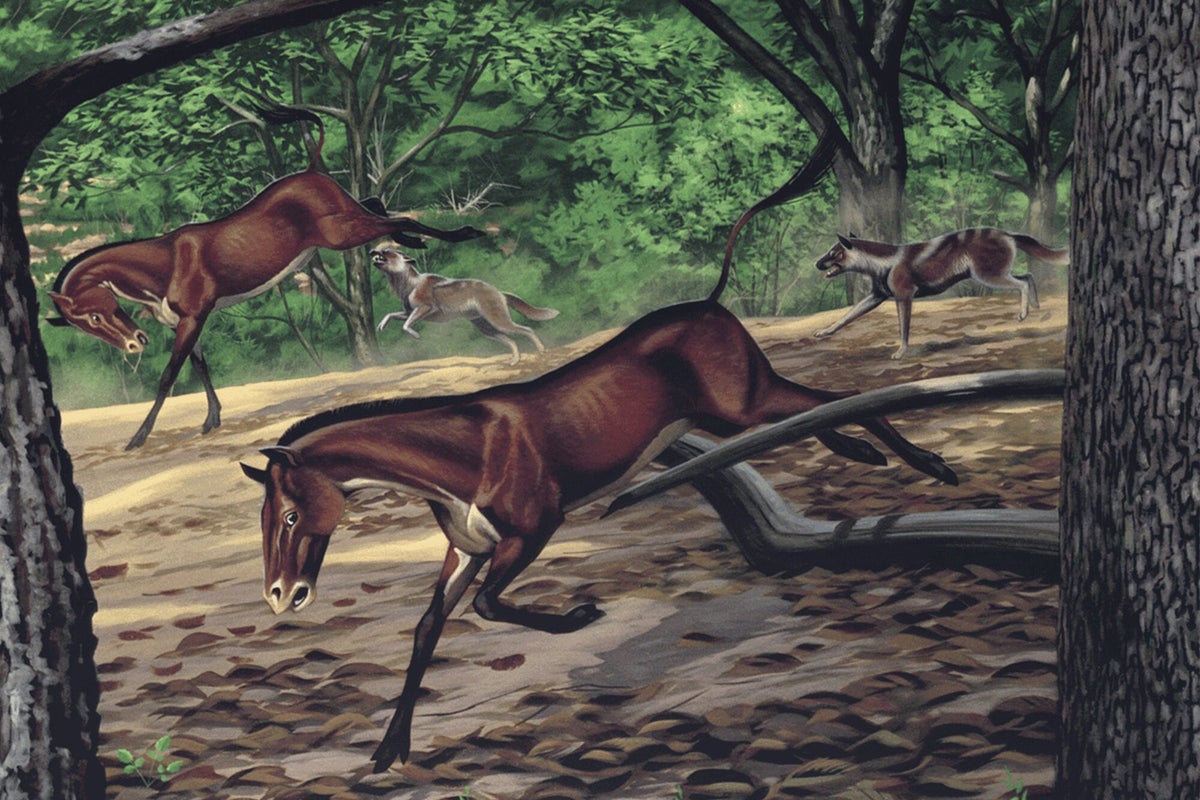
For decades a fossil found entombed in a rock in an Oregon museum collection was thought to belong to a sheep or pig ancestor.
But scientists have now discovered that it is the most complete remains yet of a pre-Ice Age dog dating to over 30 million years ago.
Palaeontologists from the University of Michigan say it belongs to a pre-Ice Age canid called Mesocyon coryphaeus.
Mesocyon emerged about 10 million years later during a period of global cooling, according to a study published in the Journal of Palaeontology.
Scientists sought to understand if they had any adaptations similar to modern dogs, and found the prehistoric canids were definitely not built for running.
"The answer is pretty definitely no...Mesocyon also just has more robust bones in general. It's shorter and stockier,” said Anne Kort, an author of the study from the University of Michigan.
In the 90s, researchers carefully extracted the fossil and its surrounding rock, wrapped it for protection in a plaster jacket, and later separated the head for display, determining it was a kind of dog.
Later in the 2010s, scientists uncovered the rest of the skeleton, realising how complete it was.
It was missing only the tail and parts of the animal's hands and feet.
Further analysis revealed that the prehistoric dog could rotate its forearms, indicating an ability to grapple and climb.
Fossil evidence suggests Mesocyon occasionally walked heel-down, instead of on its tiptoes, like dogs do today.
"This fossil is not our current dogs' great-great-great uncle, because this whole line went fully extinct. And with that extinction, we did lose a whole kind of dog ecology that we just don't see anymore," Dr Kort said.