

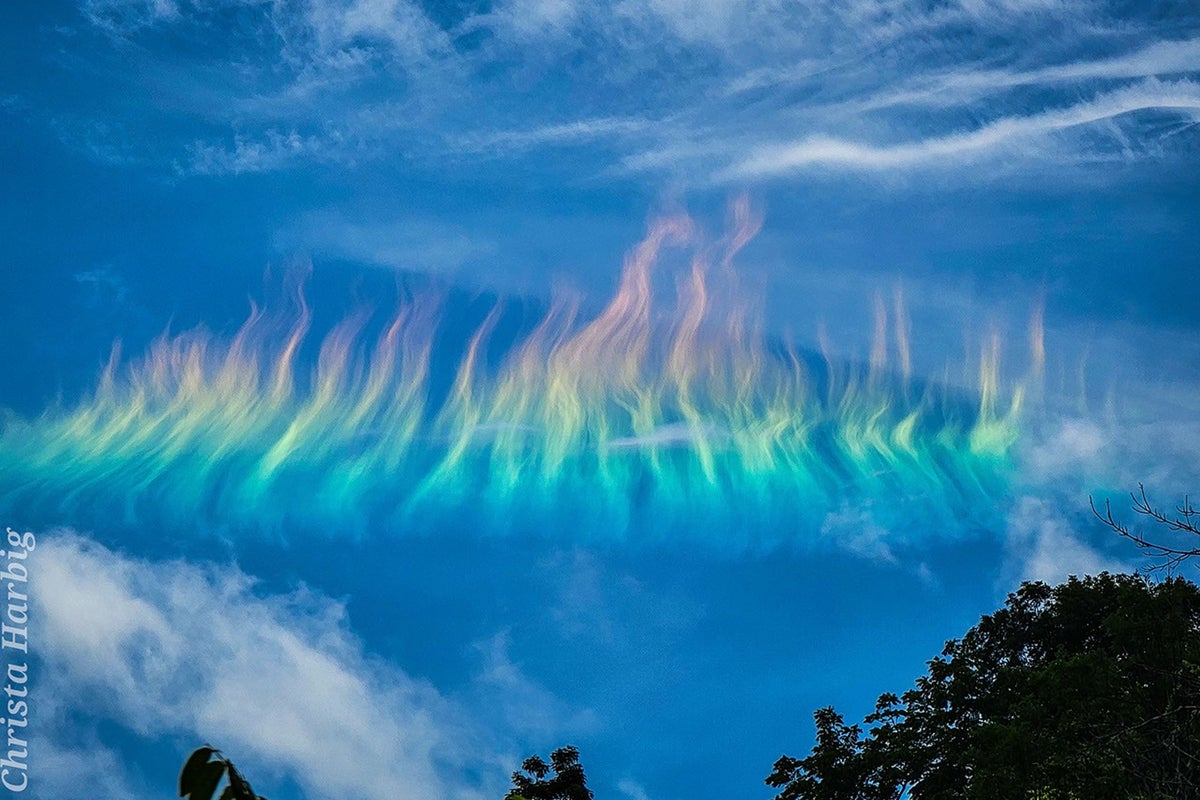
You’ve seen a rainbow, maybe you’ve witnessed a double rainbow - but what about a fire rainbow?
The stunning atmospheric phenomenon, scientifically known as a “circumhorizontal arc,” was snapped in 2021 by Ghostfire Photography’s Christa Harbig near North Fork Mountain, West Virginia, and featured in NASA’s Astronomy Picture of the Day.
The image shows layers of periwinkle blue, key lime green, butter yellow, tangerine and salmon pink. It also appears wispy, like the flickering end of a candle’s flame.
“It was an absolutely beautiful sight,” Harbig said in a message to The Independent on Tuesday.
It’s also a “somewhat unusual” thing to see, according to the space agency. And it’s not actually a rainbow, which forms from water droplets.
Fire rainbows are created by plate-shaped ice crystals in distant cirrus clouds. The crystals act like little floating prisms, which can bend and separate white light into the colors of the rainbow.
That may also help explain how this fire rainbow formed. “The numerous, flat, hexagonal ice-crystals that compose the cirrus cloud must be aligned horizontally to properly refract sunlight in a collectively similar manner,” NASA said.
Fire rainbows have been seen in multiple states from coast to coast, with recent reports in South Carolina, Massachusetts, Colorado, Wisconsin, Vermont, California and Pennsylvania.
The phenomenon is similar to rainbow clouds, that are sometimes also called fire rainbows. These iridescent clouds form on low, dense cumulus clouds after a thunderstorm, according to AccuWeather.
It’s not just Earth that has iridescent clouds, either. NASA’s Curiosity Mars rover captured red and green clouds in the Martian sky last year and previously in January 2023.
“While most Martian clouds hover no more than 37 miles (60 kilometers) above the ground and are composed of water ice, these clouds appear to be higher in elevation, where it's very cold. That suggests these clouds are made of carbon dioxide, or dry ice,” NASA explained.